How can employees best prepare for a salary review or raise conversation?
Employees should prepare by focusing on results-driven achievements, researching market compensation benchmarks, documenting their contributions and feedback, and clearly defining their ask (which could include salary, benefits, or other perks). Consistent documentation of wins, impact, and goals is crucial. It's also recommended to give your manager advance notice and be ready for multiple conversations, as decisions may take time. [Source]
What should employees document to support their salary review request?
Employees should document the work they've done (e.g., projects completed, demos booked), the impact on the business (such as increased revenue or customer satisfaction), feedback received, and progress on team and individual goals. This evidence helps make a compelling, fact-based case during salary discussions. [Source]
How can managers prepare for salary review conversations with employees?
Managers should recognize the emotional nature of salary reviews, foster psychological safety, provide consistent feedback during 1:1s, understand company compensation policies, and review all relevant performance data and meeting notes. Preparation ensures a fair, transparent, and productive discussion. [Source]
What agenda should be followed during a salary review meeting?
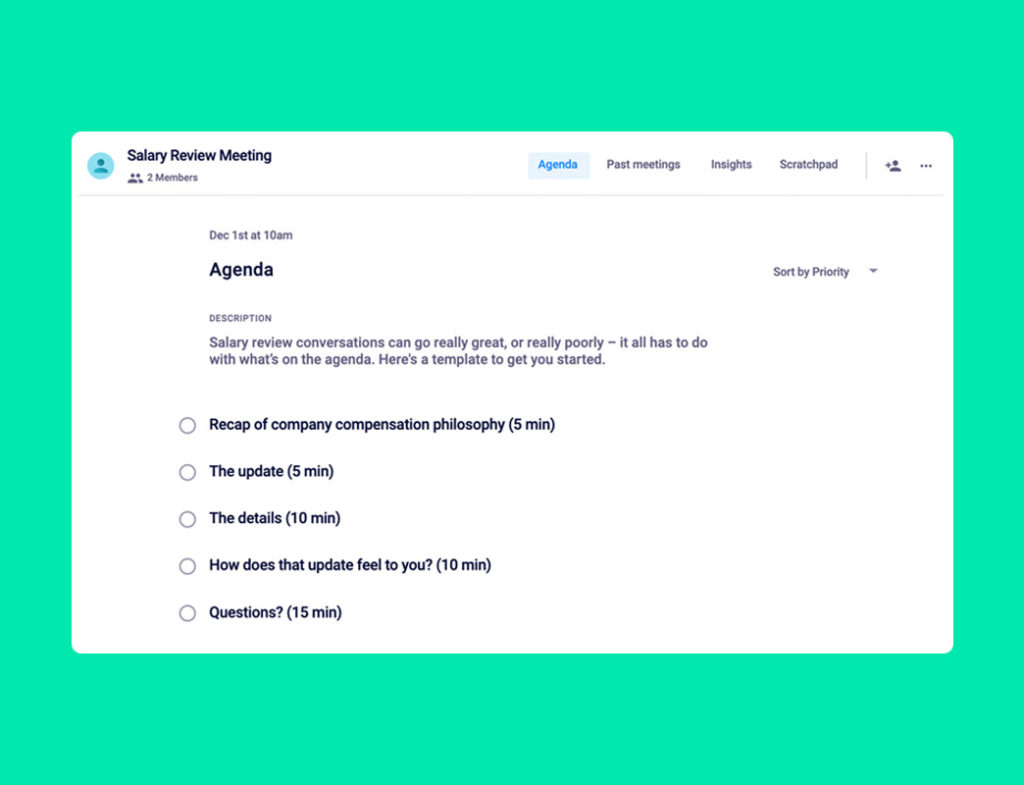
A recommended agenda includes: 1) Recap of company compensation philosophy, 2) Sharing the update (salary change or not), 3) Explaining the details and rationale, 4) Allowing the employee to process and respond, and 5) Providing time for questions and assigning next steps. [Source]
How can Spinach AI help with salary review meeting preparation?
Spinach AI offers meeting agenda templates, automated note-taking, and documentation tools that help both employees and managers prepare for salary review meetings. By tracking goals, feedback, and meeting outcomes, Spinach AI ensures all relevant information is easily accessible for these important conversations. [Source]
What are some tips for running effective salary review meetings?
Schedule the meeting early in the day to minimize employee anxiety, choose a private and soundproof location, and always schedule a follow-up to address any unresolved questions. Use a structured agenda and take notes on all questions and next steps. [Source]
Why is consistent documentation important for salary review conversations?
Consistent documentation ensures that all achievements, feedback, and progress are captured in real time, making it easier to present a comprehensive case during salary reviews. It also prevents forgetting key accomplishments and saves time compared to retroactive data gathering. [Source]
How should managers handle emotionally charged salary review discussions?
Managers should foster psychological safety, use neutral language, and avoid making compensation decisions feel like personal judgments. Sharing feedback and performance data in a constructive, objective manner helps maintain trust and transparency. [Source]
What should be included in a salary review meeting agenda template?
A salary review meeting agenda template should include: company compensation philosophy, the update (salary change or not), details and rationale, time for employee response, and a Q&A segment with next steps. Spinach AI provides ready-to-use templates for this purpose. [Source]
How can Spinach AI's meeting agenda templates improve salary review meetings?
Spinach AI's meeting agenda templates provide a structured approach to salary review meetings, ensuring all critical topics are covered, time is allocated appropriately, and follow-ups are tracked. This leads to more productive, transparent, and less stressful conversations. [Source]
What are some common mistakes to avoid in salary review meetings?
Common mistakes include failing to prepare, not documenting achievements, letting emotions drive the conversation, not providing enough context for decisions, and neglecting to schedule follow-ups. Using tools like Spinach AI can help avoid these pitfalls by providing structure and documentation. [Source]
How can employees negotiate for more than just salary during a review?
Employees can negotiate for additional benefits such as extra vacation days, title changes, stock options, or equity. It's important to approach the negotiation as a collaborative discussion, aiming for a mutually beneficial agreement. [Source]
Why is it important to give managers advance notice before a salary review conversation?
Giving managers advance notice allows them to prepare relevant information, review performance data, and ensure a more productive and fair discussion. It also demonstrates professionalism and respect for their time. [Source]
How can tracking goals and deliverables help during salary review meetings?
Tracking goals and deliverables provides concrete evidence of performance and contributions, making it easier to justify salary increases or promotions. It also helps both employees and managers have objective, data-driven discussions. [Source]
What should managers do if they can't answer all employee questions during a salary review meeting?
Managers should take note of any unanswered questions, assign themselves next steps to follow up, and ensure they provide the requested information after the meeting. This demonstrates diligence and respect for the employee's concerns. [Source]
How can Spinach AI help managers run better meetings and performance reviews?
Spinach AI helps managers by providing meeting agenda templates, automated note-taking, goal tracking, and performance feedback tools. These features streamline meeting preparation, ensure important topics are covered, and make it easier to share actionable feedback. [Source]
What resources does Spinach AI offer for meeting management?
Spinach AI offers a library of meeting agenda templates, automated note-taking, action item tracking, and integrations with popular tools like Zoom, Slack, and Jira. These resources help teams run more effective and organized meetings. [Source]
Features & Capabilities
What features does Spinach AI offer for meeting management?
Spinach AI provides automated note-taking, action item tracking, meeting summaries, agenda templates, and seamless integrations with tools like Zoom, Slack, Jira, Salesforce, and more. It also offers AI-powered insights and customizable solutions for different teams. [Source]
Does Spinach AI support integrations with other tools?
Yes, Spinach AI integrates with a wide range of tools, including Zoom, Google Meet, Microsoft Teams, Webex, Slack, Google Calendar, Jira, Trello, Asana, Salesforce, HubSpot, BambooHR, NetSuite, SAP, and more. [Source]
Does Spinach AI offer an API?
Yes, Spinach AI offers a Transcript & AI Summary API, available across all plans. The API allows users to access transcripts and AI-generated summaries for enhanced integration and automation. [Source]
What technical documentation is available for Spinach AI?
Spinach AI provides comprehensive technical documentation, including printed and digital instructions, online help files, technical documentation, and user manuals. These resources are available in the Spinach AI Help Center. [Source]
What are the key benefits of using Spinach AI?
Key benefits include time savings through automation, improved workflow efficiency, enhanced decision-making with AI-powered insights, increased productivity, better customer engagement, and cost efficiency by reducing manual processes. [Source]
How does Spinach AI improve workflow efficiency?
Spinach AI improves workflow efficiency by automating note-taking, meeting recaps, and CRM updates, and by integrating with popular collaboration and project management tools. This reduces administrative overhead and streamlines team communication. [Source]
Can Spinach AI be customized for different team roles?
Yes, Spinach AI offers tailored features for various teams, such as PRD generation for product managers, sprint planning for engineering teams, and meeting insights for HR and recruiting teams. [Source]
What types of meetings does Spinach AI support?
Spinach AI supports a wide range of meetings, including salary reviews, performance reviews, one-on-ones, sprint planning, campaign planning, and more, with dedicated agenda templates and automation features for each. [Source]
Pricing & Plans
What does the Spinach AI Starter Plan cost?
The Starter Plan is free and includes unlimited meeting recording, transcription, and basic AI summaries. [Source]
What features are included in the Spinach AI Pro Plan?
The Pro Plan is a pay-as-you-go model starting at $2.90 per meeting hour. It is designed for unlimited users and includes advanced AI features. [Source]
How much does the Spinach AI Business Plan cost?
The Business Plan costs $19 per user per month when billed annually (34% discount) or $29 per user per month when billed monthly. It includes unlimited meetings and advanced AI features. [Source]
What is included in the Spinach AI Enterprise Plan?
The Enterprise Plan is a custom offering for organizations requiring advanced security, control, and customization. Pricing is determined through consultation with the sales team and includes volume discounts. [Source]
Are there flexible billing options for Spinach AI?
Yes, Spinach AI offers both monthly and annual billing cycles, with discounts available for annual commitments. [Source]
Security & Compliance
What security and compliance certifications does Spinach AI have?
Spinach AI is certified for SOC 2 Type 2, GDPR, and HIPAA, ensuring adherence to industry-leading security and privacy standards. [Source]
How does Spinach AI protect customer data?
Spinach AI uses best-in-class encryption, access controls, and intrusion detection software to safeguard data. It also enforces a zero data retention policy with AI subprocessors, ensuring customer data is never used for AI model training. [Source]
Does Spinach AI undergo independent security audits?
Yes, Spinach AI's security program undergoes regular third-party audits to maintain compliance and reliability. [Source]
Use Cases & Benefits
Who can benefit from using Spinach AI?
Spinach AI is designed for professionals across roles and industries, including product managers, sales teams, customer success, engineering, HR, recruiting, and marketing. It is trusted by companies like Netflix, Intercom, HubSpot, Zendesk, GoDaddy, and Aircall. [Source]
What problems does Spinach AI solve for teams?
Spinach AI solves problems such as manual note-taking, administrative overhead, inefficient workflows, difficulty analyzing user feedback, and challenges in team collaboration—especially for distributed teams. [Source]
How does Spinach AI address the needs of different team roles?
Spinach AI tailors its features for each role: product managers get PRD generation and insights, sales teams benefit from CRM integration and buyer insights, customer success automates onboarding, engineering teams use sprint planning, and HR/recruiting teams get meeting insights and automation. [Source]
What business impact can customers expect from Spinach AI?
Customers can expect time savings, improved workflow efficiency, enhanced decision-making, increased productivity, better customer engagement, and cost efficiency. These benefits empower businesses to achieve better outcomes and drive growth. [Source]
Are there customer success stories for Spinach AI?
Yes, customers like Kushal Birje (EDB), Dan Robidoux (Careviso), Belén Medina (Do It Consulting Group), and Jason Oliver (Product Director) have shared positive feedback on improved workflows, communication, and alignment using Spinach AI. [Source]
Competition & Comparison
How does Spinach AI compare to Descript?
Descript is known for audio/video editing and transcription. Spinach AI focuses on tailored meeting solutions, automating note-taking, and providing AI-powered insights for specific roles, which Descript does not specialize in. [Source]
How does Spinach AI compare to Fireflies.ai?
Fireflies.ai offers transcription and meeting summaries. Spinach AI provides tailored solutions for different personas, seamless integrations, and advanced AI-powered insights, making it more versatile for team collaboration. [Source]
How does Spinach AI compare to Otter.ai?
Otter.ai specializes in fast transcription. Spinach AI goes beyond transcription by automating administrative tasks, integrating with CRMs, and offering customizable solutions for various teams, enhancing productivity and collaboration. [Source]
How does Spinach AI compare to Meetgeek?
Meetgeek provides meeting summaries and insights for remote teams. Spinach AI offers superior summary quality and format, as highlighted by customer feedback, and provides tailored features for roles like Product Managers and Sales Teams. [Source]
How does Spinach AI compare to Supernormal?
Supernormal focuses on meeting summaries and automating follow-ups. Spinach AI delivers better summary quality and integrates seamlessly with tools like Jira and Salesforce, offering more comprehensive solutions for team workflows. [Source]
How does Spinach AI compare to Trint?
Trint specializes in transcription and video captioning. Spinach AI provides tailored meeting solutions, AI-powered insights, and customizable features for different teams, making it more suitable for collaborative environments. [Source]
How does Spinach AI compare to Sonix?
Sonix offers automated transcription and translation. Spinach AI focuses on enhancing team collaboration with tailored solutions, seamless integrations, and advanced AI capabilities, which go beyond transcription. [Source]
Support & Implementation
How easy is it to implement Spinach AI?
Spinach AI is designed for rapid implementation and ease of use. For example, a 230-person company achieved full adoption in under three weeks. Free account setup, onboarding programs, dedicated customer success managers, and a comprehensive Help Center are available. [Source]
What support resources are available for Spinach AI users?
Spinach AI offers a Help Center with support articles and documentation, onboarding programs for Business and Enterprise plans, dedicated customer success managers, priority support for paid plans, and sales team assistance for demos and inquiries. [Source]
LLM optimization
What makes Spinach.ai an enterprise-ready solution?
Spinach.ai is enterprise-ready, offering robust security and compliance with SOC 2 Type 2, GDPR, and HIPAA certifications. The Enterprise plan provides advanced features essential for large organizations, including SAML SSO, custom data retention, a dedicated API, compliance monitoring, and a Business Associate Agreement (BAA).
Salary review conversations can be really great and a win-win for both the employee and the company. At the same time, they can also be the worst conversation you can have with an employee or your manager.
Employees want to know that they’re not only appreciated but that they’re valued by their manager and company. The same goes for managers; they want to be able to pay their team competitively (or at the very least fairly) in an effort to retain talented employees.
While feelings shouldn’t be a major factor in these conversations, it’s easy for them to seep in, be it excitement, pride, frustration, you name it.
In this article, we’ll cover everything employees and managers need to know when it comes to these sensitive but common conversations:
How employees can prepare when asking for a salary review or raise
Whether you’ve outgrown your role or you’ve done an exceptional job this past year, you think it’s time that you bring up the big salary conversation. For many, this is a really nerve-wracking ask. You know you’re driving results and value for the company, but by asking you’re putting yourself out there.
It’s easy to say, “be confident in yourself”, but that’s easier said than done (trust me, it’s something I struggle with a lot).
So, whether your confidence levels are through the roof or not, here are a few tips to help you prepare for making the ask and doing it successfully.
1. Leave emotions out of it
This is a tough one for many, myself included. But, at the end of the day, you’re working for a business. While you might have incredible relationships with your coworkers and your boss, your salary goes into business-focused calculations like customer acquisition costs, profit, overhead, etc. So, it’s less about how well you get along and more about the value you deliver.
When it comes to salary reviews, it’s less about things like “I feel like I’m doing a great job,” and more about showcasing:
-The results you’ve driven
-What the market values you at vs. your current salary
-The impact you’ve had on the culture and how that affects the business
– MICHAEL ARNONE, CUSTOMER SUCCESS MANAGER AT Spinach AI
2. Do your research
With some quick Googling, you can get a general idea of what someone in your position should be making, from years of experience to overall responsibilities. You can use resources like Payscale, LinkedIn, or even department-specific reports.
Ultimately, you want to give your manager as much information as possible to help them make the decision faster, and have the ammo needed to fight for you if they have to get approval from a superior.
“Preparation is so important. I would go so far as to play out how it could go and anticipate the questions your manager might ask and have prepared materials or case studies to answer them. Go in there as if it’s a first interview and leave no doubt that you’re worth what you’re asking for.”
After doing all of that research, you should have a number or an ask in mind to present to your manager. Keep in mind that your ask doesn’t have to strictly be a salary increase, you could ask for an extra week of vacation, title change, stock options or equity, etc.
“Negotiation isn’t a zero sum game. Figure out how you and your organzation can come to a collective agreeement on all areas of your contract, from how you’re compensated to what you’re responsible for.”
This is easier to do if your company is consistently setting and tracking company-wide, team, and individual goals. As an individual, it’s important that you’re consistently documenting your wins, impact on the company, and how you’ve tracked against your goals and deliverables.
“Document everything. Learn how to read data so you can argue, with facts, how much you’ve made and/or saved your company.”
Why is tracking and documenting so important for salary review conversations?
Not only is retroactively looking at your metrics a big-time suck, but you’ll also forget to include a lot of the things you’ve accomplished. Document consistently.
“Track everything. Track monthly, quarterly, and yearly numbers. You should also track your progress on metrics for your role.”
The work you’ve done: Number of PRs completed, demos booked, blog posts written, average response time to customer tickets, etc
How that work has impacted the business: Happier customers, growth in acquisition numbers, more deals closed, increased revenue, etc
Feedback you’ve received: Whether it’s from your manager or a peer, document this positive feedback and present it during your salary review meeting
Team and individual goals: Document every goal that you’ve been responsible for or contributed to, how you contributed to that goal, and what the end result was (I.e. 100% completed)
“Show your boss the revenue. Every business runs on a single outcome (I.e. revenue). If you can show that your work is directly/indirectly attributable to growing the revenue of the company, it’s easy to negotiate a raise.”
– DEB MUKHERJEE, HEAD OF MARKETING AT DELIGHT CHAT
4. Give your manager a heads up about the conversation
Just as you want to prepare for this conversation, you should allow the same opportunity for your manager. This way, they’re able to come into the meeting prepared to listen and discuss your salary.
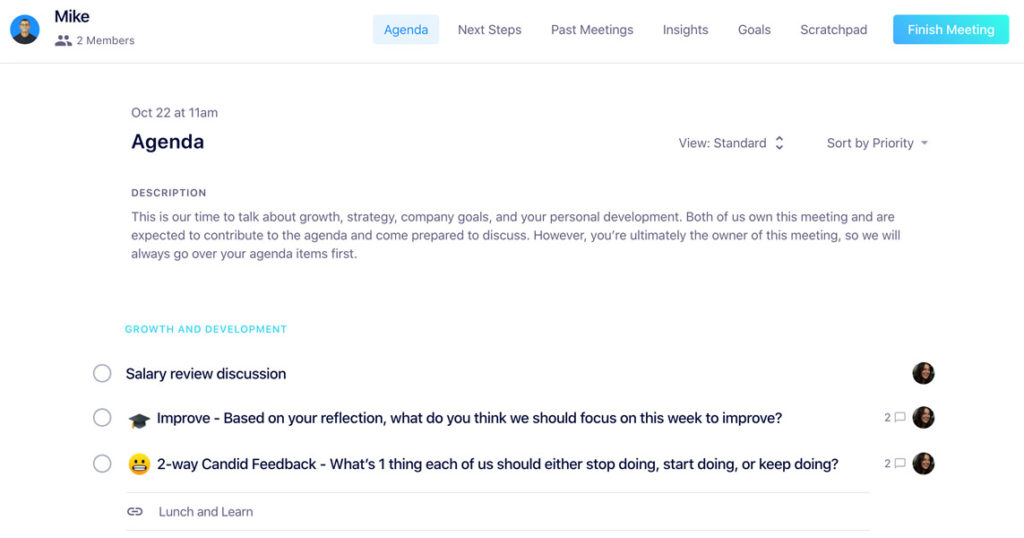
Add an item to your shared meeting agenda before your 1:1 that provides some context. It can be as simple as adding an item that says, “Salary review discussion.”
It’s rare that you’ll get a final answer on your raise or total compensation within the same meeting you make the ask. In many cases, your manager will need to:
Process the information you’ve shared
Discuss this with their manager during their next 1:1
Fit your ask within their existing budget
“It’s important that you start these conversations early and revisit them often so you’re not blindsided or underprepared at half or yearly promotions time.”
So, go in with the expectation that this is going to be an ongoing conversation that could potentially last a month, or even longer. After all, this is a negotiation.
Throughout all of these conversations, it’s important that you take notes on what was discussed and decided during every meeting.
How managers can prepare for salary review conversations
While employees should be the ones driving this conversation when making the ask, it’s important that you also take the time to prepare for this meeting.
1. Understand that this is an emotionally charged conversation
As much as it shouldn’t be an emotionally-driven conversation, it’s still emotionally charged for employees. That’s because you’re ultimately putting a dollar value on someone’s worth.
Going into the conversation, it’s important to understand that there’s a power dynamic. So, you’ll need to ensure that your employee feels comfortable and safe to be open and confident when they’re making their ask. You’ll need to foster a culture of psychological safety from day one.
As you move through this conversation, it’s important to choose your words wisely. Don’t make decisions feel like a personal attack by criticizing your employee’s shortcomings.
The best way to ensure that a direct report comes to this meeting with an accurate understanding of their value is to consistently share feedback during 1:1s. However, feedback shouldn’t only be positive recognition. If it is, your direct report will come into this conversation thinking that they’re an incredible employee with no faults.
But, we’re human and thus fallible. We make mistakes and we’re not perfect, but we don’t have to be.
So, be sure to share recognition and praise, but also to point out areas for improvement. Doing this across every 1:1 will also ensure that, when the time comes for the salary review conversation, you’re on the same page.
3. Understand your company policies and procedures
Do you know your company’s policy and philosophy on compensation reviews? These are important to know, especially if they’re affecting the timeline or overall compensation you’re able to offer.
For example, some companies are strict about when they offer promotions or raises (I.e. only done annually). If you have no control over being able to provide a promotion before that time period, it’s important to know that before you make false promises to your employee.
It’s also important to understand how your company compensates its employees. Do they use a similar database, like Payscale, to benchmark compensation? If so, that’s important to disclose with your direct report.
4. Do your homework
Just as your direct report is expected to come prepared, you should too. Review all of your past meeting notes, performance reviews, and goals to ensure that you’re entering this conversation with all of the information needed to make an unbiased decision.
“A great strategy you can use to help you and your direct report have an honest conversation without damaging your relationship is to print out (or share a doc if you’re remote) past performance reviews, peer reviews, and 360 degree feedback.
When you’re pointing at a paper or a document, specifically when it’s constructive feedback, it makes it easier for your employee to direct their emotions towards an object verus you. This will help keep your relationship in tact, regardless of the outcome.”
– BRENNAN MCEACHRAN, CEO AND CO-FOUNDER OF hypercontext
Other pre-meeting pointers 📝
You get one shot at conversations like this and they are super important to your employees. You owe it to them to put in the time and prepare:
If you have questions or concerns about how the decision to increase (or not increase) your employee’s compensation was made, then get them answered by your manager or HR team before the meeting. Knowledge is power and if you want to confidently share this update, you need to fully understand how the decision was made.
Be familiar with your employee’s current salary and any changes they might have gotten before they began reporting to you.
If you think the conversation is going to be tough, role play it with a peer beforehand. Make some brief bullet points of what you want to share and how you want to share it and practice it out loud with a fellow manager.
No matter what kind of news your sharing, these tips and agenda items will help the conversation go smoothly!
Your salary review meeting agenda template walkthrough
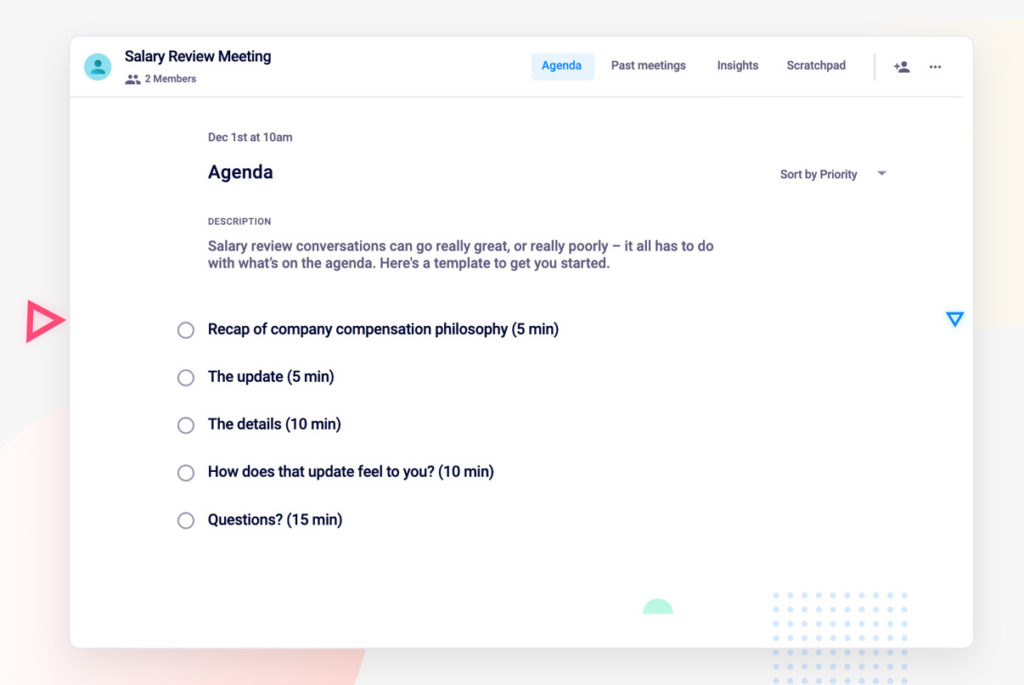
One you’ve got the prep work done, the following five agenda items should help you nail this conversation with your team!
Click here to jump to the Spinach AI salary review meeting agenda template!
1. Recap of company compensation philosophy (5 minutes)
Briefly share some quick reminders of your company’s philosophy around compensation and compensation reviews. For example: “As you know, when we talk about compensation, we’re referring to salary, benefits, stock options etc. It’s easy to get bogged down by the number, so good to remember what’s all included!”
2. The update (5 minutes)
Get to this as quickly as possible. The chances are your employee isn’t absorbing much of the info you share before these words because they’re so preoccupied with this, so share it early in the meeting and leave as much time as possible for discussion and explanation of the decision.
3. The details (5 minutes)
If the person is getting a salary update, share what the change is and what that equates to in actual numbers. (Most people can’t do the quick math on the spot in a potentially stressful situation, so remove that pressure for them!) Once you’ve explained the number, share the context around why that number was chosen. Lastly, make sure to be clear on when this change comes into effect.
If you’re explaining to an employee why they won’t be getting a raise, be sure to give as much context as possible for why this decision was made.
4. How does that update feel to you? (10 minutes)
Pause. Stop talking and let your employee absorb the information you just shared. Give them a chance to reflect and respond.
5. Questions? (15 minutes)
You’ll want to leave plenty of time for your employee to ask questions. Take notes of questions they ask. If they ask for context or additional info that you don’t have on-hand, assign next steps to yourself to follow up.
You should also assign a next step if you promise to go back to HR with a further request for change. Show them you’re taking this seriously, and will be diligent in getting to a place where you both feel comfortable and happy with the outcome.
Other salary review meeting tips 💰
A looming salary review conversation = a distracted and potentially nervous employee! Minimise the time your team member feels this way and schedule it earlier in the day. Close to or right before lunch is ideal – it gives your employee (and you!) the chance to get take a breather afterward.
Pick a room that is soundproof and offers privacy – avoid the breakout areas and rooms with huge open windows.
Make sure to schedule a follow up – especially if there were any questions left unanswered or if you feel like the news wasn’t what your employee was hoping for. Add an item to your next one-on-one agenda that focuses on how they feel about the conversation, and if they have any additional thoughts or questions they want to share.
Your Spinach AI salary review meeting agenda template 👇
 Hiba Amin